Kevin Bemel ·
Why You Embody Unification
Parsha [Passage of Scripture] Nugget [Precious Idea] Shemos – Terumah 25:1-27:19
When my friend Greg told me fundraising was about making Jews rather than raising money I thought it was the setup to a clichéd joke. Had I absorbed the lesson of Parshas Terumah I would have known better:
“And they will make for me a sanctuary and I will dwell in their midst.” (Shemos/Exodus 25:8).
This Sabbath’s parsha details the plans for the Mishkan or portable Sanctuary in which G-d rested His Presence during the Israelites’ wanderings in the wilderness. Such ordinary materials as copper, linen, and goatskins are turned into a holy abode.
The Torah spends 13 chapters describing the details of constructing the Mishkan. Compare that to the description of creation, one chapter, and the revelation at Mt. Sinai, three chapters. Obviously Moses built something more than a fancy tent.
G-d’s first dwelling place on earth embodies the entire purpose for which the world was created.
The Midrash and other commentaries describe the Mishkan as a model of man, the physical universe, and creation. The Mishkan's kaylim or vessels are seen as representations of the various human organs and faculties. The Ark, containing the Torah, corresponds to the mind, intellect, and the power of speech. The Menorah symbolizes the eyes and sense of sight. The Table that held the "showbread” stands for the sense of taste. The Inner Altar, on which the incense was burned, typifies the sense of smell. The Outer Altar, on which the animal and meal offerings were brought, represents the digestive system and related organs.
Maimonides described the universe as consisting of three strata: 1. Unrefined matter, the earth and all terrestrial creatures, 2. Refined matter, the stars and heavenly bodies, and 3. Wholly spiritual beings, entities that are "form alone, without matter, such as the angels which are not physical bodies but various forms.” The Mishkan reflects these three realms: 1. The courtyard, 2. The outer chamber of the Sanctuary known as the "Holy,” and 3. The inner chamber, behind the Paroches or curtain, known as the “Holy of Holies.”
These three realms can also be described as physical, mental, and spiritual, conforming to your life. The Mishkan unified separate spaces for each realm into a cohesive whole.
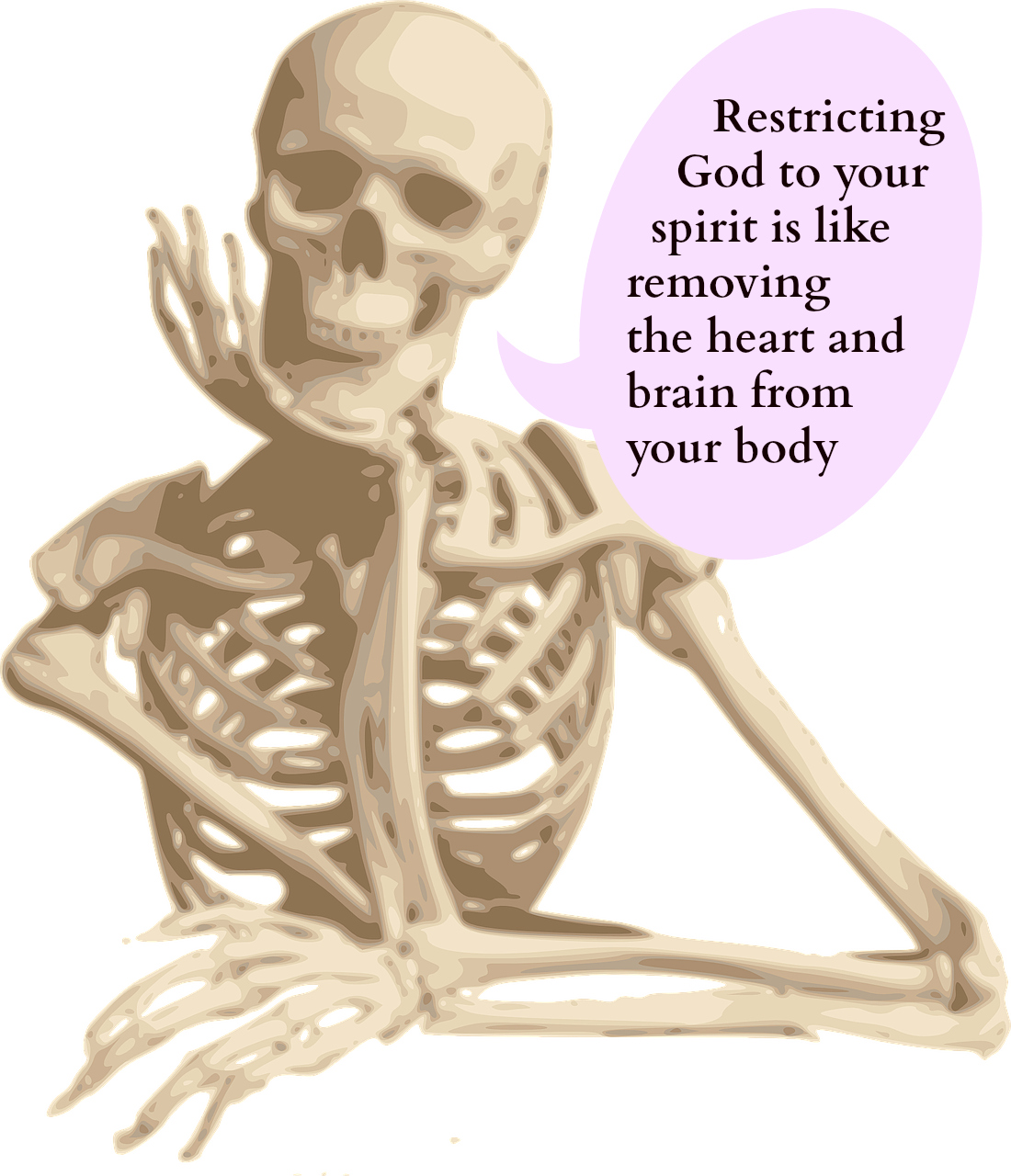
The musculoskeletal structure embodies physicality. The brain epitomizes the mental realm. The heart symbolizes spirituality. The body integrates these three systems into a human being.
The tendency is to relegate God and Scripture to the spiritual realm. But the Almighty never contemplated such distinctions. While life has recognizable domains, you represent their unification. So, there is no such thing as acting purely in one.
[Tweet "Your Every Act Creates Waves in the Physical, Mental, and Spiritual Realms"]
Whether for your diet, marriage, finances, or prayer, consider the implications in all realms of life as you decide the direction you will take.
What can you do that has impact in only one realm?
Every year beginning on Simchas Torah, the cycle of reading the Torah, the first five books of the Bible, ends and begins again. Each Sabbath a portion known as a sedra or parsha is read. It is named after the first significant word or two with which this weekly reading begins.
What verse in the Old Testament would you like to know more about? Ask here and I will answer it in a future Parsha Nugget!
