Kevin Bemel ·
Riding the Submarine Rescue Chamber: On a Trapeze Without a Net
Did you ever play the game where you had to trust someone by falling backwards, counting on the person to catch you? Then you know a little about what it is like to journey to the ocean floor aboard the Submarine Rescue Chamber, know as the SRC.
Qualifications are the lifeblood of the navy. From the moment a sailor comes aboard a command he is under pressure to get checked out on his various duties so he can work on his own and train others. The submarine service has one of the original qualification awards, the Submarine Warfare Insignia. My father, zt"l, who was an anti-submarine warfare officer in the mid 1950s, had tremendous admiration for sailors who wore the “Dolphins.”
But chaplains are not allowed to earn warfare qualifications including the coveted submariners’ “Fish.” (I know, dolphins are not fish. But are you going to argue with a guy who runs a nuclear reactor?) The Marine Corps made special arrangements for chaplains to earn the Fleet Marine Force pin. The only other one I can get is the Parachute Badge. But do I really want to jump out of a perfectly good airplane just to win a fancy brass pin for my uniform?
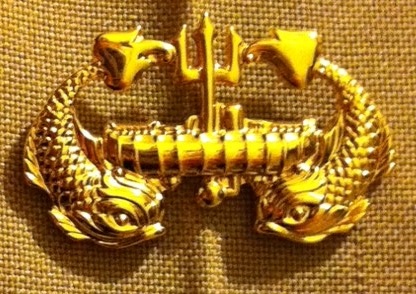
Then I learned Submarine Squadron 11 staff members are eligible for the Deep Submergence Insignia rescue pin. It is not dolphins, but it has Neptune’s cool trident and a couple of fish too. What is more, I would be the first chaplain earn it.
Like most quals, it involves demonstrating an understanding of the history and purpose of this particular navy activity and getting signed off on a practicum. The deep submergence program was created to rescue submariners trapped in a disabled submarine. The most famous is the rescue of 33 sailors off the USS SQUALUS on the eve of World War II. Peter Maas’s book The Terrible Hours is a great recounting.
Fast-forward, you may recall my October 1 Facebook post of the SRC. Entering the chamber is like going through a time warp. If life were in black and white I would have expected John Wayne or maybe Cary Grant to welcome me aboard.
Do you like elevators? Me either, even when they have a glass wall. Imagine one that has really uncomfortable seats, lots of incomprehensible gauges and valves, and requires you to sit shoulder to shoulder with your shipmates. Oh, and it is very warm inside, even before the hatch is closed. We have been sitting inside for about 45 minutes when we are told via the umbilical cord that the oxygen supply system is not working quite right. Standby!
Fixing the ventilation consumes an hour. Now surface personnel release the safety and clear us to start our descent. Down we go. Twenty minutes later we are at the bottom of San Diego Bay. But the apparatus we had to link with is covered with silt. Divers scramble from the surface to clear it. After a while we call for a status report but the topside operator does not answer. We are vaguely disturbed.
More than two hours into what I was told would be an hour and a half evolution, sitting in semi-darkness, completely useless, I am thinking, “What is a perfectly sane #NavyRabbi doing here?!” Oh, nature is calling and there are no facilities in this thing.
But hallelujah, we marry up with our link. We call the surface to advise them of our success and begin our ascent. After four hours in the pretzel position climbing out is a challenge. But the sun welcomes us to land. Knowing we would be hungry since the mission lasted almost three times longer than it should, our shipmates have ordered pizza. Too bad it was not kosher.
Saying thanks, my qual card signed, I head back to Point Loma to learn my orders have been cancelled. The government shut down while I sat on the sludge of the bay.
Reflecting on my latest adventure I was struck by how absolutely helpless we were. Aside from the discomfort, we were completely reliant on our shipmates on the surface for air, communications, and troubleshooting. The only thing we could do on our own was move up and down. I had not experienced this level of dependency in almost half a decade.
You know what? I trust anyone of my shipmates to catch me as I fall backwards. And I am going to build the same level of trust here in civilian life. Would you like to help?
How do you establish trust with friends and colleagues?
You can leave a comment on this question or ask another question below ↓
