Kevin Bemel ·
Why You Should Make Wile E. Coyote Your Hero
2-½ minutes to read
Saturday morning cartoons were one of the great rituals of my childhood. Bugs Bunny was the star attraction during the early 1960s. Then in 1966, The Road Runner Show debuted. What prepubescent boy could resist such slapstick mania? Nonetheless, during the initial two-year run of the Road Runner and Coyote cartoons, my dad fumed about the violence. (In truth, I welcomed the break from his complaining about sugar cereal and candy advertisements.) For years I’ve gone along with rooting for the Roadrunner and deriding the Coyote. Now I can finally go public. Wile E. Coyote is my hero!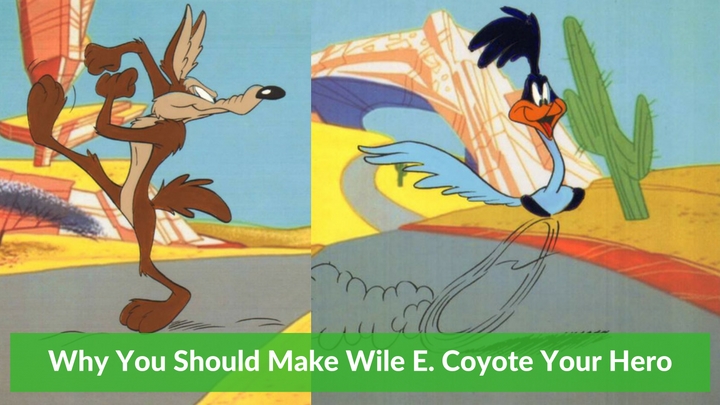
A Metaphor for Life
Chuck Jones and Mike Maltese, who created the characters, wanted to parody of various chase cartoons like Tom and Jerry. At the risk of sounding supercilious, they carry a deeper message. I didn’t consciously perceive this as a kid. But in every episode, Wile E. fought an existential battle of success and failure. And though he never caught the Roadrunner, the Coyote consistently won his fight because he kept trying.
Throughout the series, the Roadrunner never changed. Not once did he rely on anything other than his speed or luck to evade capture. Despite his hero status, the Roadrunner behaved despicably. I hated the show’s theme song. The lyrics, “Poor little roadrunner never bothers anyone; just running down the road is his idea of having fun” were not true. The Roadrunner taunted Wile E. in every episode. And often he gloated when one of the Coyote’s schemes went awry. By any measure, he displayed poor sportsmanship.
The Roadrunner gained accolades merely for following his nature. The Coyote was trying to capture his food. Is there anything more natural? Yet he was demeaned despite his creativity and tenacity. As every week went by, my desire for Wile E.’s success deepened.
The Qualities of a Hero
Long before he spoke with an English accent, I respected Wile E.’s erudition. As I write this, I realize his drawings may have given rise to my fascination with machinery. In any event, if you seek personal development, the Coyote exemplifies it:
- Goal. Wile E. set a goal that would stretch him. Let face it, he could have found sustenance elsewhere. But he chose to pursue a challenging objective. You can’t argue the Roadrunner was unattainable. While not a diet staple, real coyotes catch and eat them.
- Plan. Wile E. used his mind to overcome the gap between the Roadrunner’s strengths and his own. You might argue his schemes were too complex. But he never approached his prey ad hoc. He had a plan. When it didn’t work, often he would learn from his failure and modify it.
- Technology. Wile E. was not a Luddite. He experimented with new technology. In this respect, he was perhaps the first futurist. He stretched the boundaries of science and engineering in pursuit of his objective.
- Action. Wile E. acted. He didn’t over plan. He never allowed himself to get so caught up in his stratagems he failed to execute them.
- Resilient. Wile E. never gave up. Ever. His resilience formed the foundation of his greatness.
You might argue that Wile E.’s lack of success bars him from the pantheon of heroes. But success is not the mark of a hero. Too often people sacrifice their principles to gain success. I don’t find such people laudable. Rather, heroes retain their ideals in the face hardship.
Toward the end of his career, Wile E.’s animators had him parody himself with the phrase, “Wile E. Coyote, super genius.” Whenever he said that, I heard him say, “Wile E. Coyote, my hero.”
How do you decide who will be your heroes? Please comment below.
